



AI is changing user journeys, how clients evaluate value, and how agencies try to adapt to the new realities. We surveyed 73 SEO agencies to understand how trends grow, and what are the biggest constraints agencies face today.
Research methodology
We asked 73 SEO agencies to complete an online survey about their revenue, team size, pricing strategies, growth patterns, and how AI is changing their business.
The survey covered monthly recurring revenue, client churn, pricing barriers, and what they’re investing in for 2026.
The responses came from all types of agencies. From solo consultants to teams of 200+ employees. They work in different niches too, from local businesses to enterprise clients.
We analysed the data to see what’s really happening in the SEO agency world right now. To access the data insights, click here.
Key insights from the study
- 70% of SEO agencies make under $50k in monthly recurring revenue. Most agencies are still small, lean operations.
- Lead generation remains the number one growth constraint at 39.7%. But AI’s impact on perceived SEO value is a close second at 24.7%.
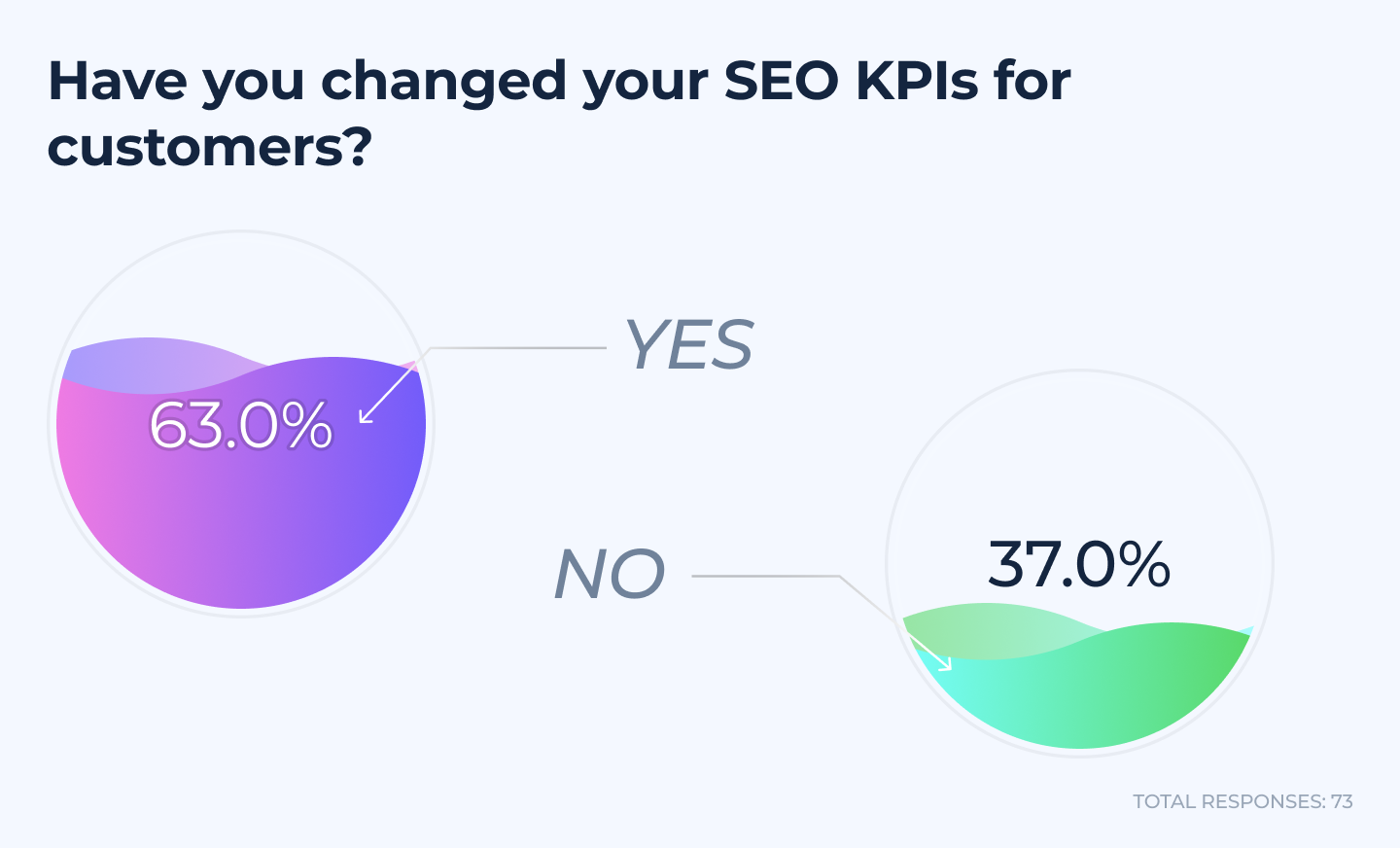
- 63% of agencies have already changed their SEO KPIs because of AI Overviews and how search behavior is shifting.
- Nearly half of all agencies (48%) indicated competition as their biggest pricing barrier. It’s getting harder to charge premium rates.
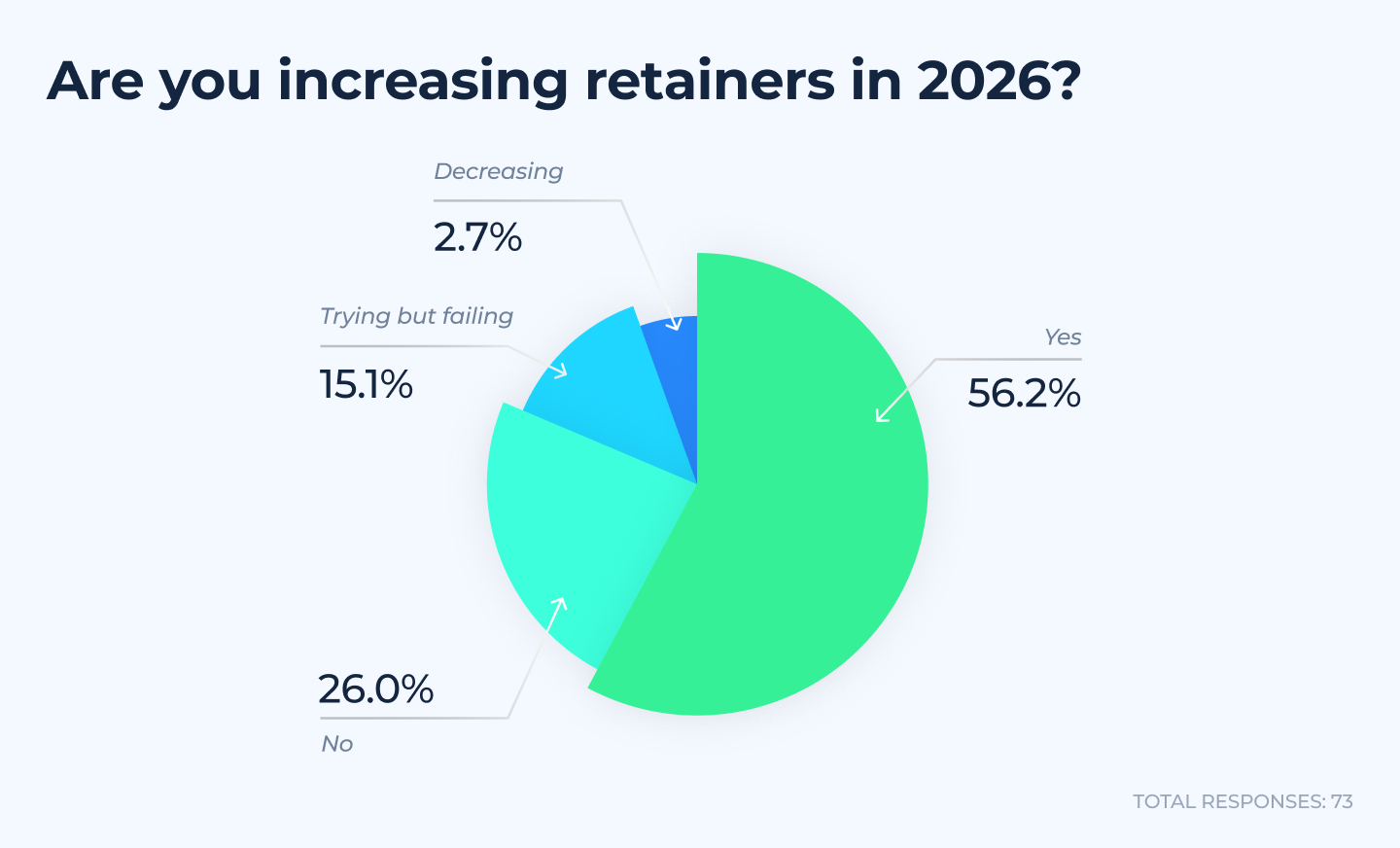
- 56.2% of agencies are successfully raising retainer prices in 2026. Another 26% are holding steady and refusing to lower them.
Agency size and revenue distribution
Monthly recurring revenue
Most SEO agencies are still pretty small. Over half (50.7%) generate less than $20k in monthly recurring revenue. Another 19.2% are in the $20k to $50k range.

Only 12.3% of agencies reported revenue over $200k per month. This tells us that scaling an SEO agency to seven figures annually is still tough for most people.
Team size
Solo practitioners and small teams dominate the agency niche.

- 37% have between 2 and 10 full time employees.
- 35.6% of agencies are solo operations.
- Just 11% of respondents are larger agencies with 10 to 50 employees.
- Only 8.2% have teams of 50 to 200 people.
- Another 8.2% reported having over 200 employees. These are probably full service digital agencies with SEO as just one service line.
Primary niches served
- Multi industry work dominates at 34.3%.
- Ecommerce comes in second at 23.3%.
- Local businesses and enterprise clients each represent 13.7% of agency focus.
- SaaS accounts for 9.6%.
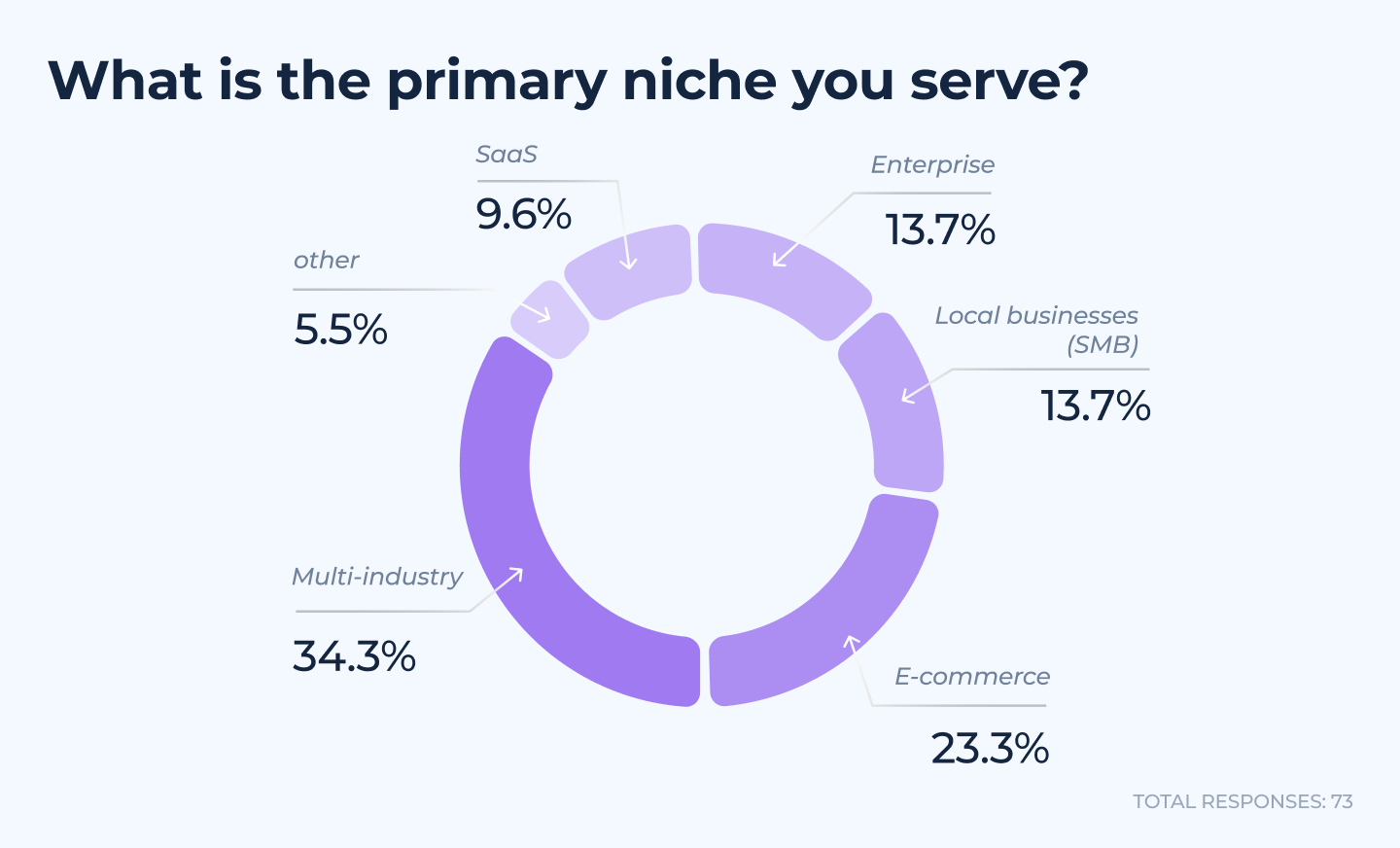
Most agencies avoid deep specialization. They prefer serving diverse client types rather than focusing on just one job.
Pricing and profitability
Average monthly SEO retainer
Pricing remains pretty low for most agencies.
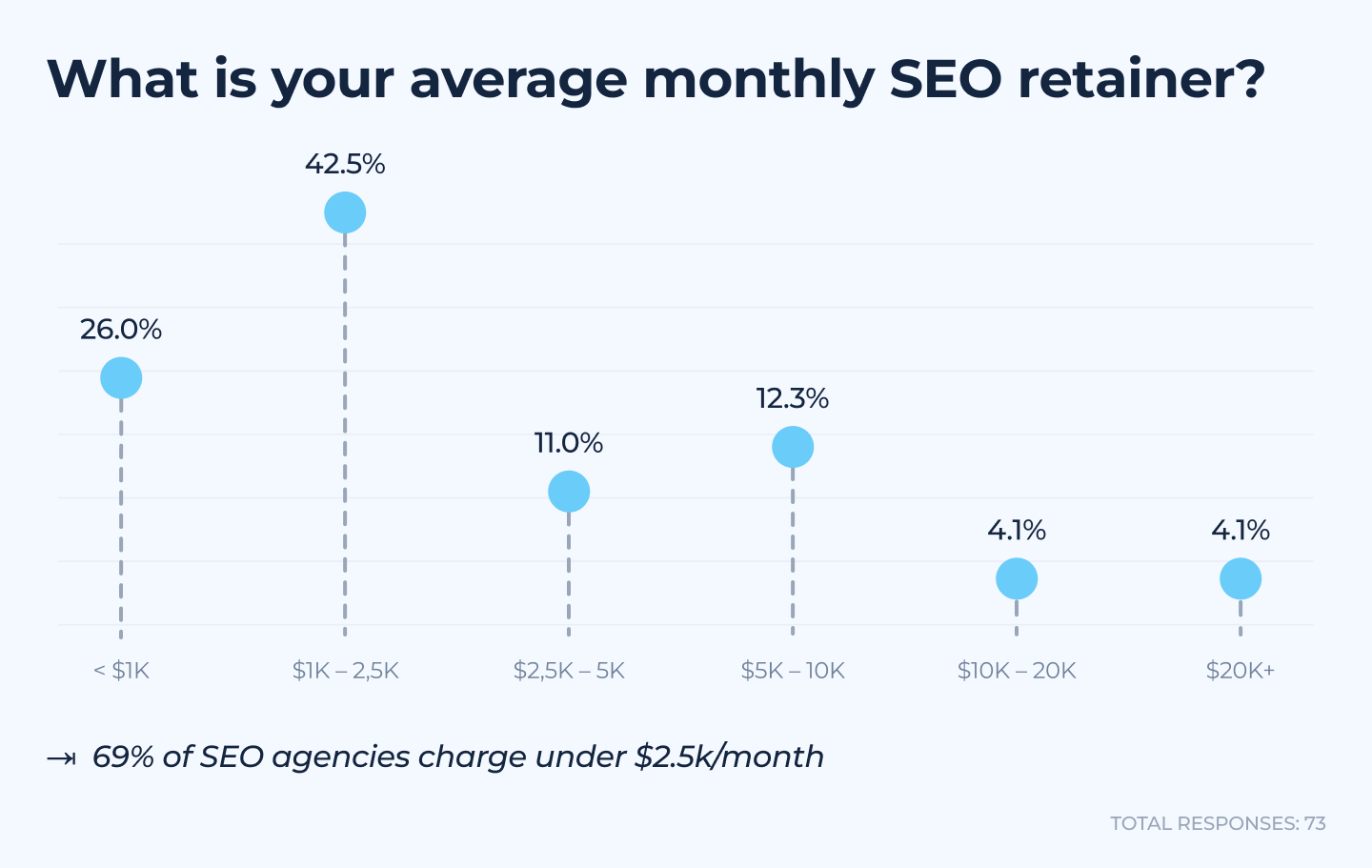
- Only 12.3% of agencies command retainers between $5k and $10k.
- 42.5% charge less than $1k per month for SEO services.
- Another 26% charge between $1k and $2.5k.
- Just 8.2% charge above $10k monthly.
This concentration at the low end explains why so many agencies struggle to scale past $50k MRR.
Gross margins
Most agencies operate on pretty thin margins. 41.1% report gross margins under 30%. Another 39.7% fall in the 30% to 50% range.
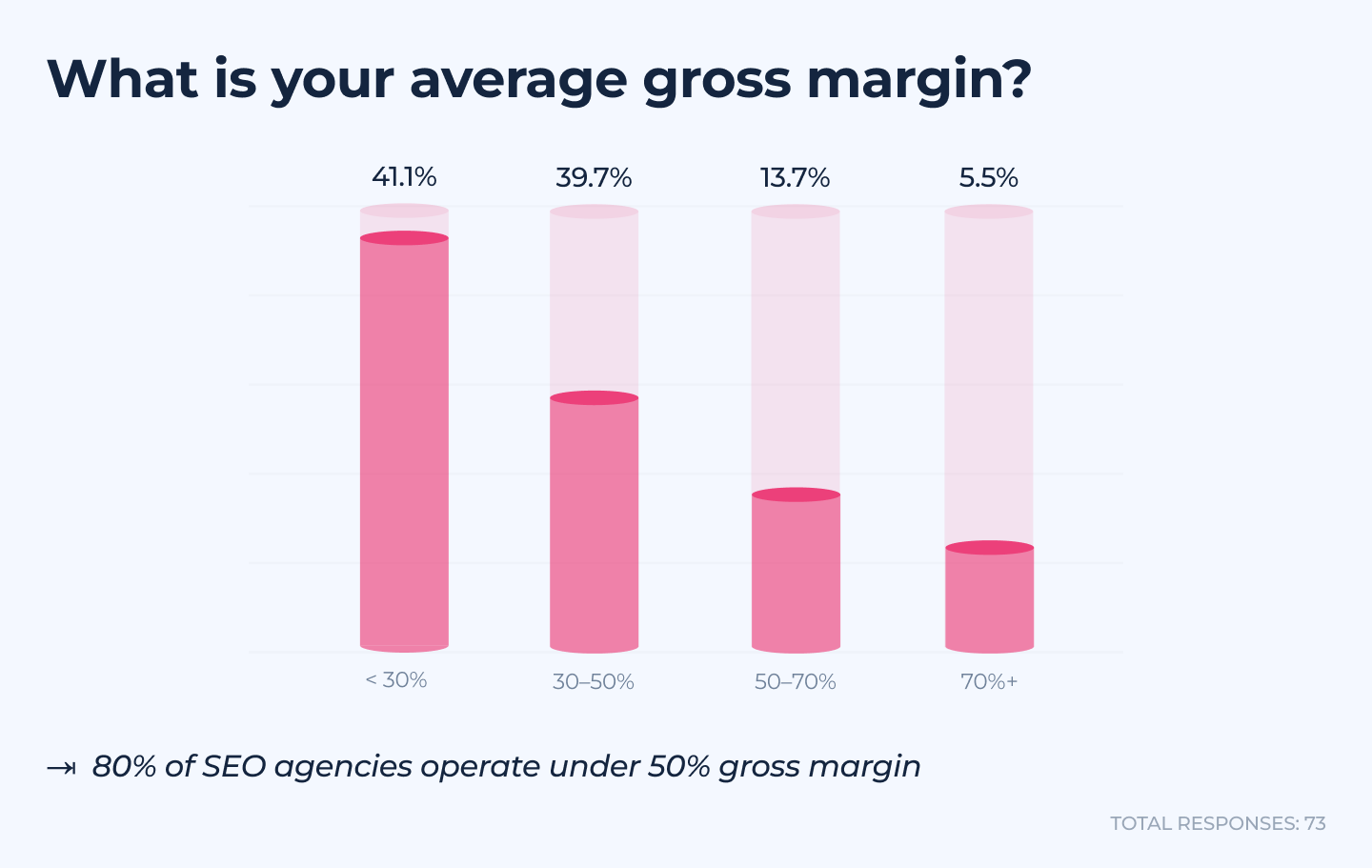
- 41.1% report gross margins under 30%.
- Another 39.7% fall in the 30% to 50% range.
- Only 13.7% achieve margins between 50% and 70%.
- Just 5.5% exceed 70%.
These low margins make it really hard to invest in growth, hire new people, or improve client churn.
Pricing barriers
Competition tops the list at 48%. Client ROI doubts come in second at 37%. Internal confidence issues affect 8.2% of agencies, while 6.9% cited other barriers.
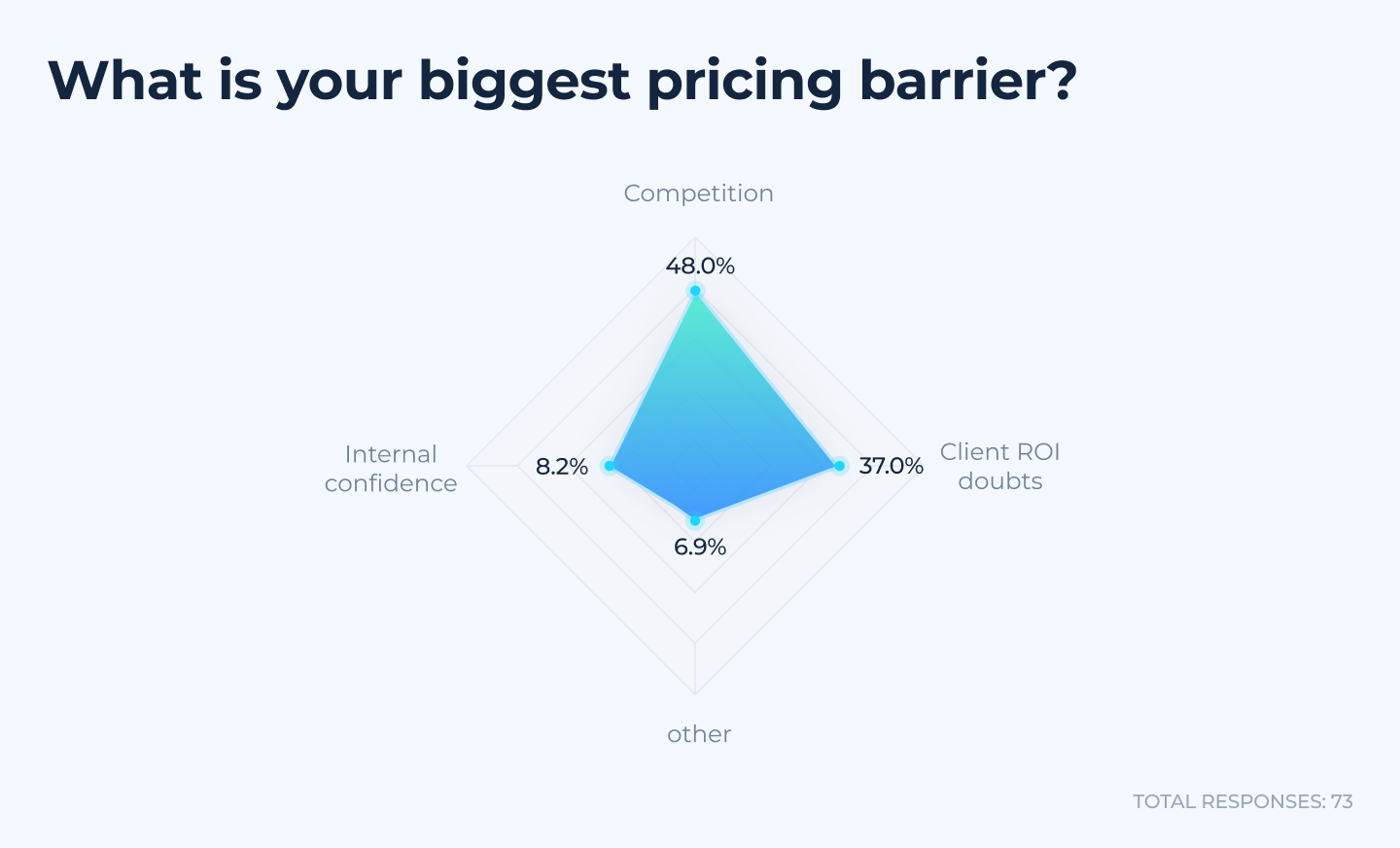
Competition and ROI concerns dominate here. This tells us that agencies are struggling to differentiate their services and prove value in ways that justify premium pricing.
Growth and churn patterns
Main growth constraints
- Not enough qualified leads is the top growth constraint at 39.7%.
- AI impact reducing perceived SEO value comes in second at 24.7%.
- Client churn affects 17.8% of agencies.
- Weak differentiation in the market is at 16.4%.
- Delivery capacity and hiring challenges impact 13.7%.
- The founder being a bottleneck reports for 12.3%.
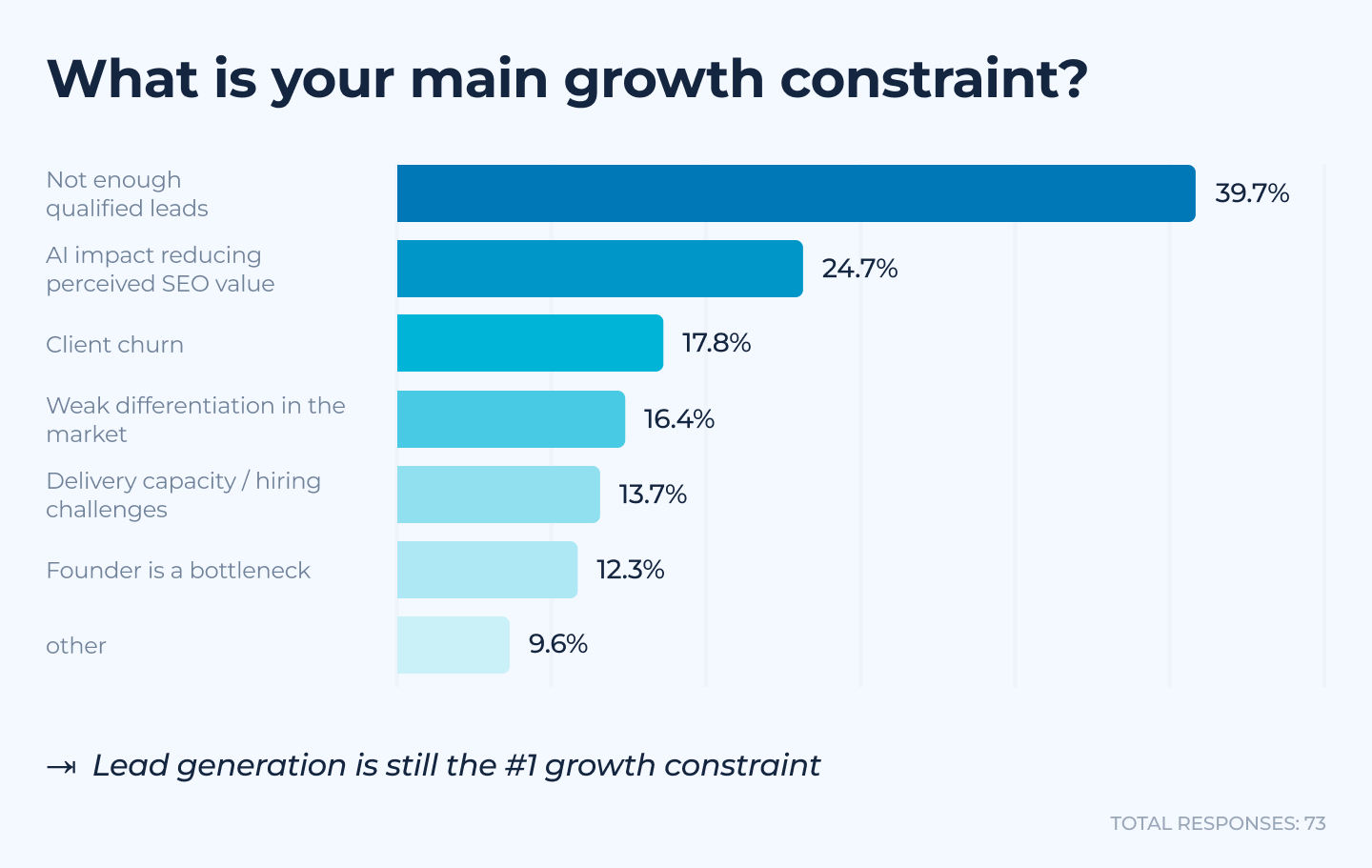
The combination of lead generation struggles and AI’s impact on perceived value shows agencies are fighting on two fronts. They need more clients, but they also need to convince those clients that SEO still matters.
Revenue growth in 2025
Most agencies saw modest growth. Growth is happening, but it’s slow. The environment is challenging right now.

Retainer price changes in 2026
Over half of agencies (56.2%) are raising retainers in 2026. Another 26% are holding prices steady. 15.1% are trying to raise prices but failing to get client buy in. Only 2.7% are actively decreasing prices.
This suggests most agencies recognize the need to improve unit economics rather than race to the bottom.
Client churn patterns
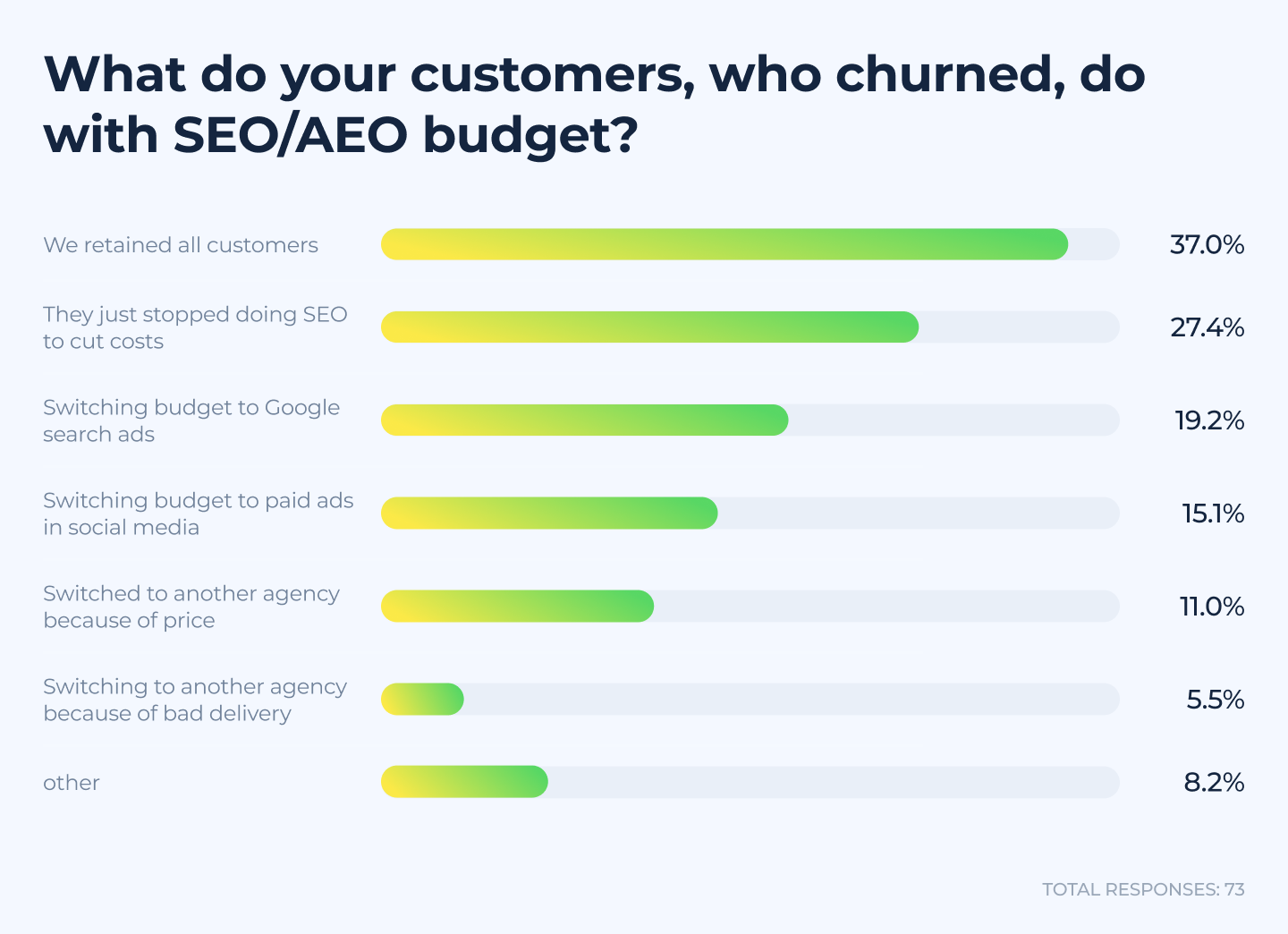
When clients leave:
- 37% of agencies manage to retain them. They probably adjust scope or pricing.
- 27.4% report clients simply stop doing SEO to cut costs.
- 19.2% of churned clients shift budget to Google search ads.
- 15.1% move to paid social.
- 11% switch to another agency because of price.
- 5.5% leave because of poor delivery.
The fact that over a quarter of clients are abandoning SEO entirely is a real problem. Agencies need to address this perception issue.
AI’s impact on SEO agencies
How agencies are adapting to AI overviews
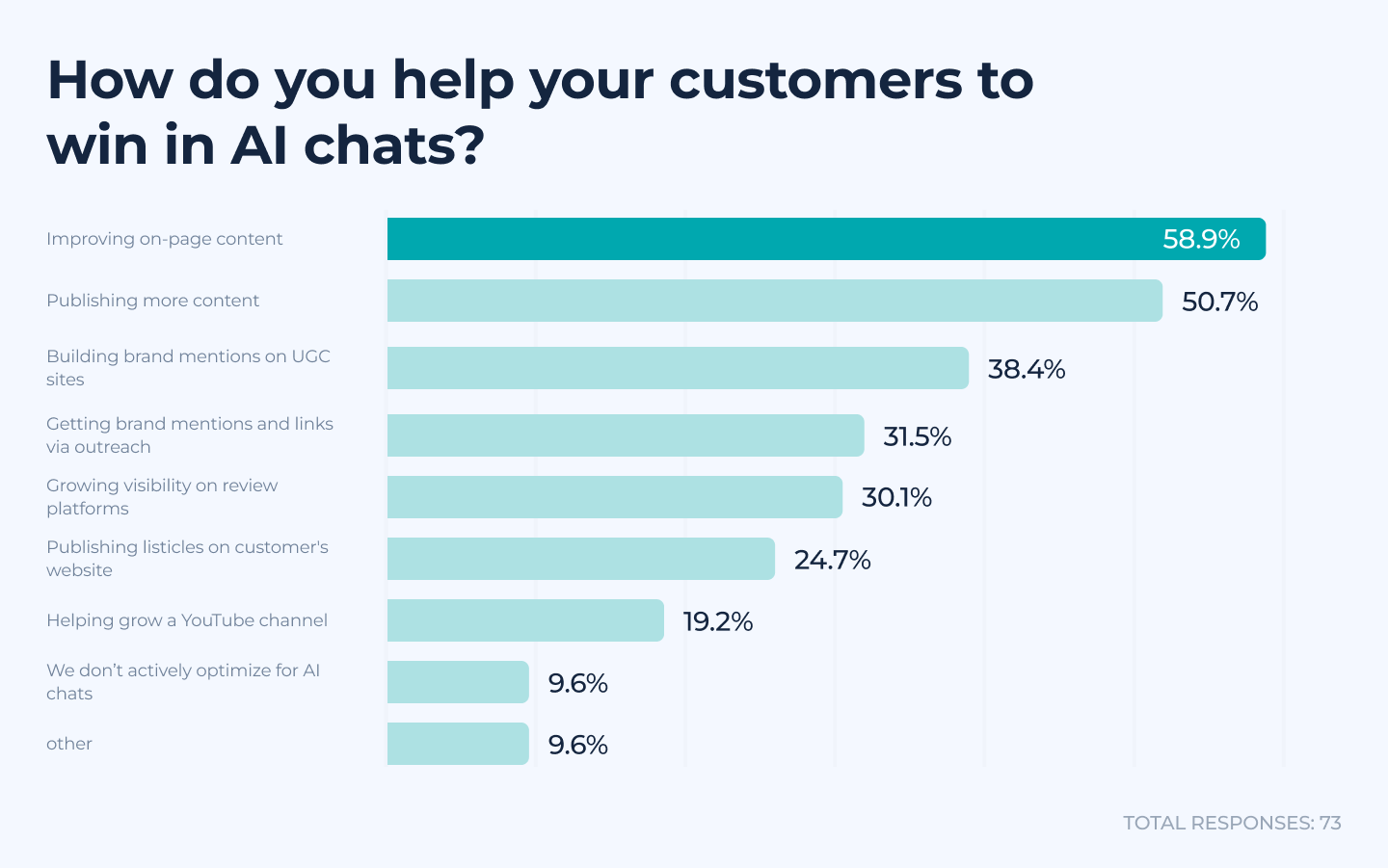
Agencies are responding to AI search in different ways:
- 58.9% focus on improving on page content.
- 50.7% are publishing more content overall.
- 38.4% are working to build brand mentions on user generated content sites.
- 31.5% are pursuing brand mentions through outreach.
- 30.1% are growing visibility on review platforms.
- 24.7% are publishing listicles on client websites.
- 9.6% iterestingly report they don’t actively optimize for AI chats at all.
Some agencies are either unaware of the shift or choosing to ignore it.
Changes to SEO KPIs
A significant 63% of agencies have already changed their SEO KPIs. They’re accounting for AI search and how user behavior is shifting.
This majority shift shows that most agencies get it. Traditional metrics like rankings and traffic don’t tell the full story of SEO performance anymore.
Current SEO and AEO KPIs
The top KPI are:
- Overall revenue from organic search and AI chats at 53.4%.
- Overall traffic comes in close at 46.6%.
- SERP positions for non branded keywords still matter to 43.8% of agencies.
- Brand visibility in AI chats is now tracked by 37% of agencies.
- Organic traffic by non branded keywords monitor 31.5% monitor.
- Website citations in AI chats are measured by 27.4%.
- Track closed deals attributed to search via user polls – only 20.6%.
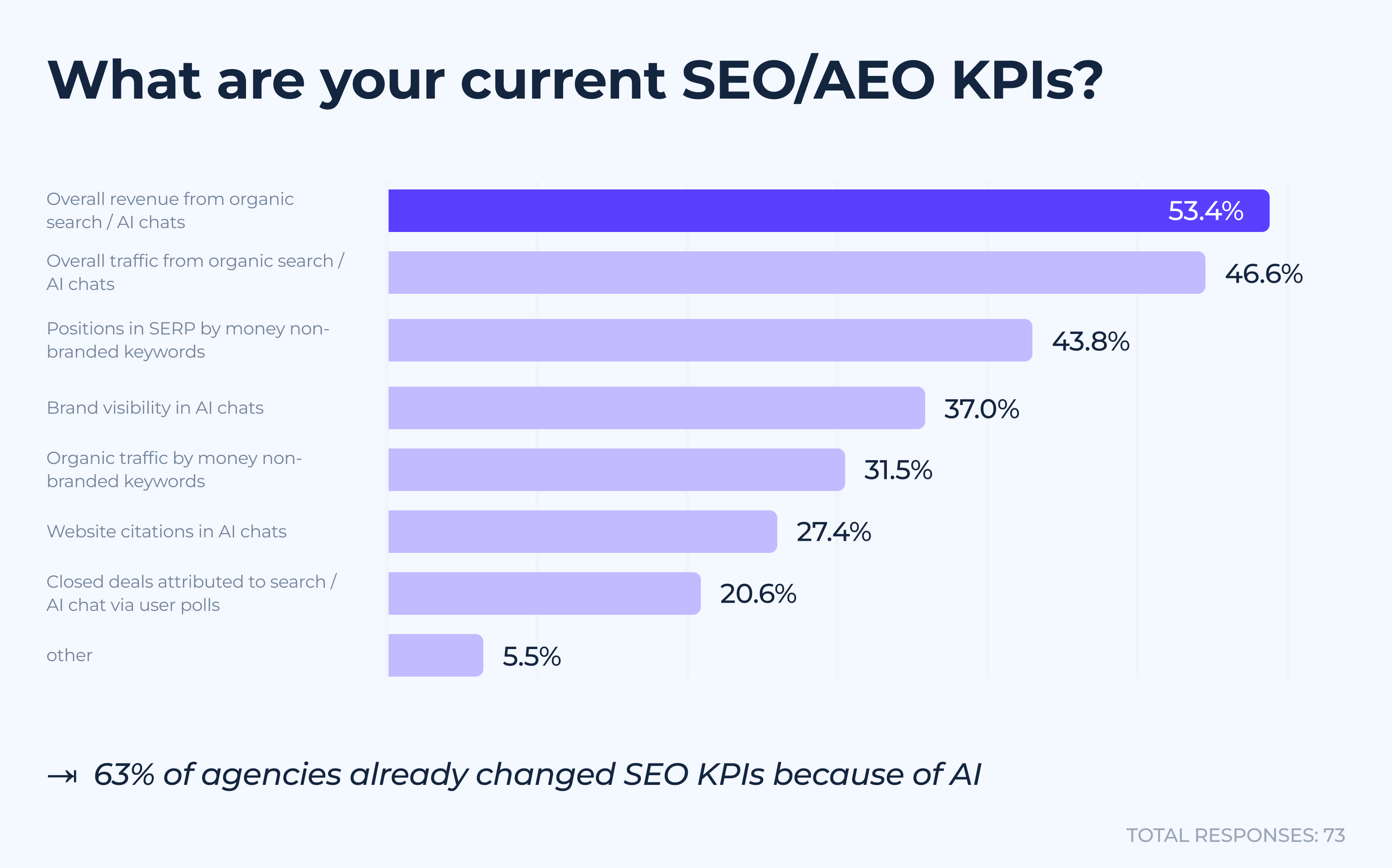
Agencies are trying to blend old and new metrics here. They’re mixing traditional SEO measures with AI specific indicators.
Google Ads response to organic traffic loss
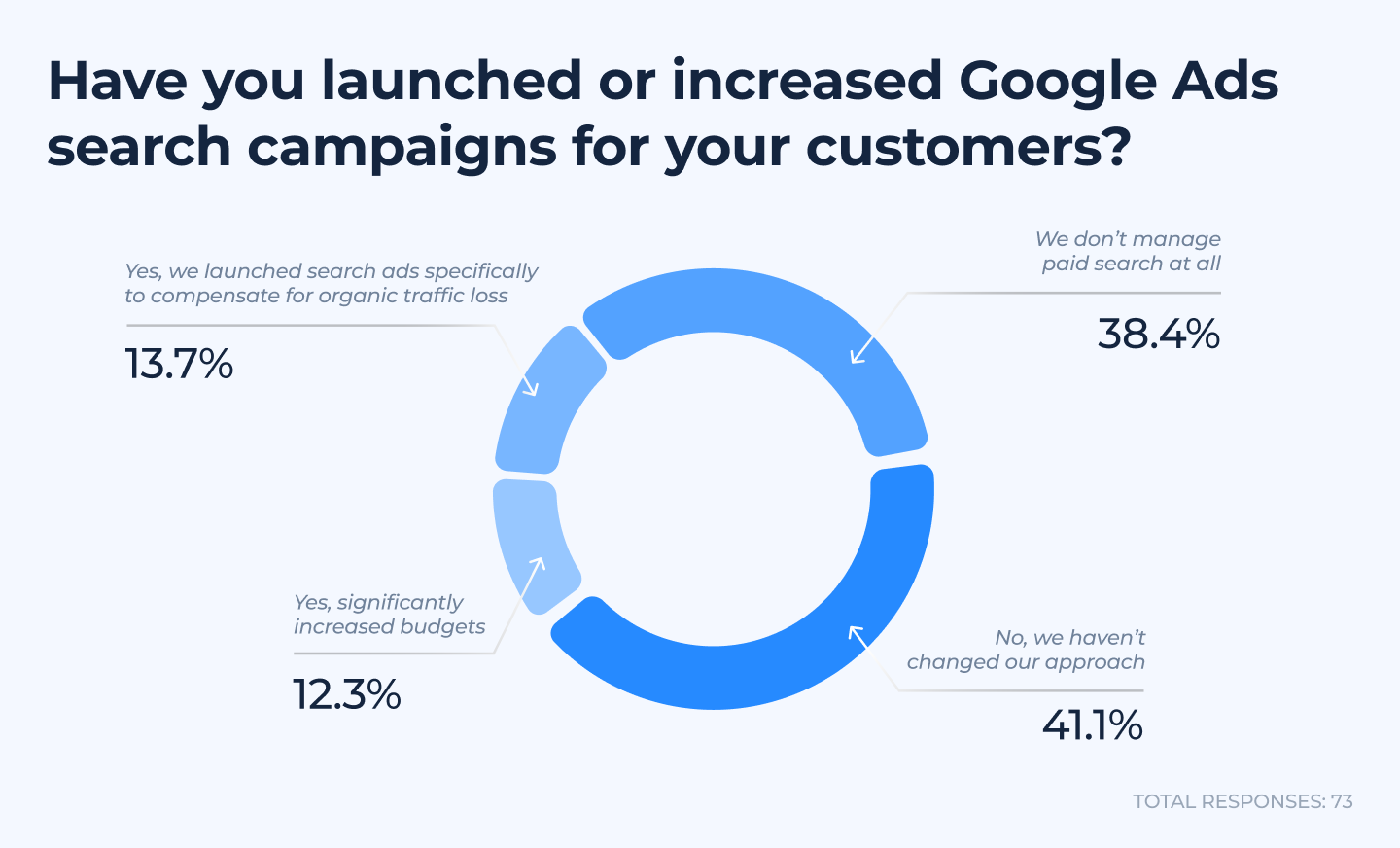
Most agencies (38.4%) don’t manage paid search at all. But 13.7% launched search ads specifically to compensate for organic traffic loss. Another 12.3% significantly increased search ad budgets. 41.1% haven’t changed their approach to paid search.
They’re either confident in organic recovery or not yet seeing enough impact to motivate a shift.
Shifting client expectations
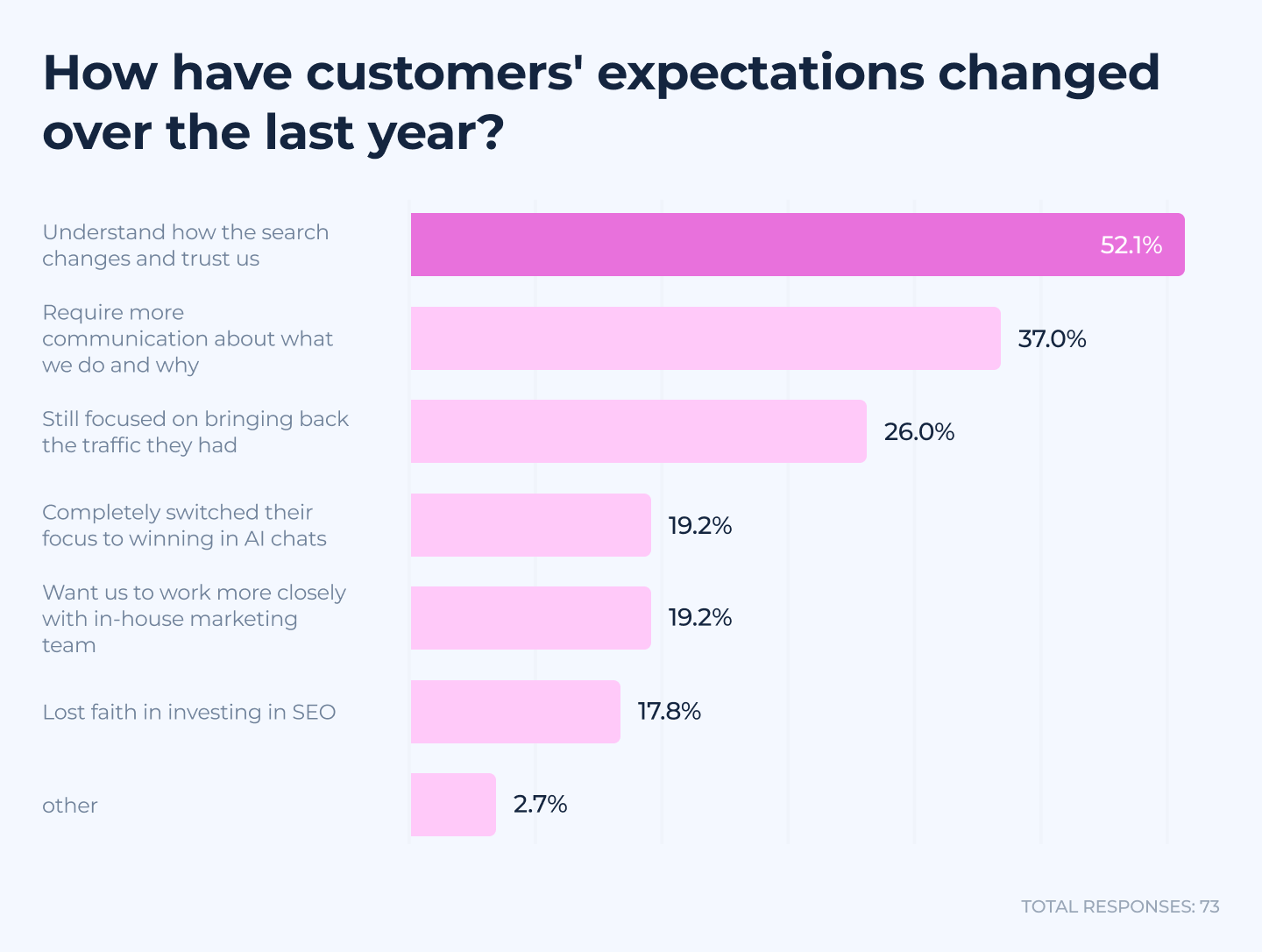
Clients increasingly want agencies to understand search changes and trust them. They also require more communication about what agencies do and why .
- 26% of clients still focus on bringing back the traffic they had before AI Overviews launched.
- 19.2% have completely switched focus to winning in AI chats.
- 19.2% want closer collaboration with in house marketing teams.
- 17.8% have lost faith in SEO altogether.
That’s a meaningful segment that agencies need to win back through education and results.
Agency concerns and investment priorities
Top worries for 2026
The biggest concern is that SEO impact on revenue is becoming harder to measure (45.2%). Close behind is the fear that Google Ads and AI Overviews are eating organic traffic (43.8%).
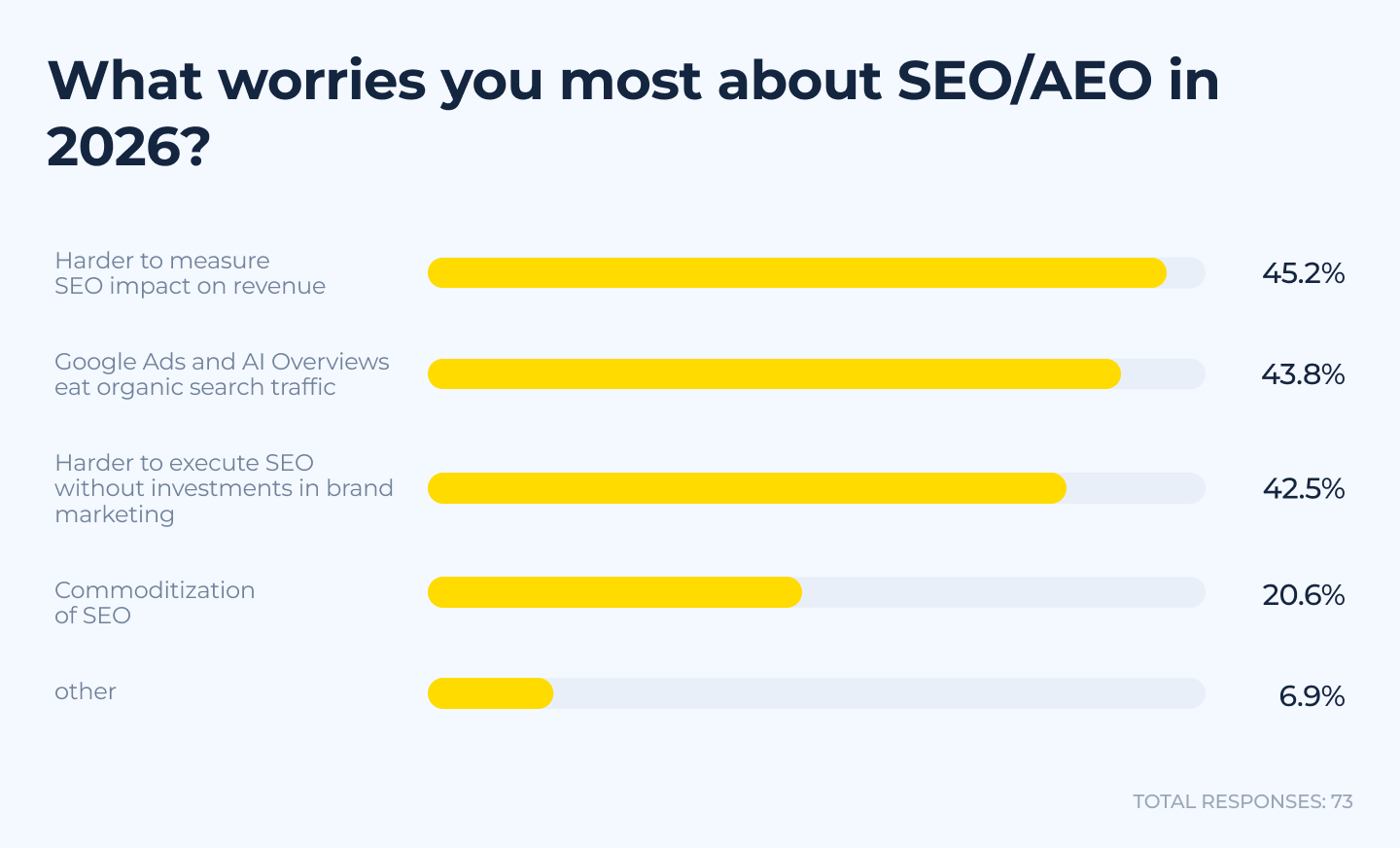
42.5% worry it’s harder to execute SEO without investments in brand marketing. 20.6% fear the commoditisation of SEO services. 6.9% listed other concerns.
These worries show that a niche is in transition. The old playbooks don’t work as well. Proving value requires new approaches.
Investment priorities for 2026
Agencies are betting big on efficiency. 60.3% are building automations to reduce the cost of SEO delivery. 53.4% are building better SEO and AEO tool stacks.
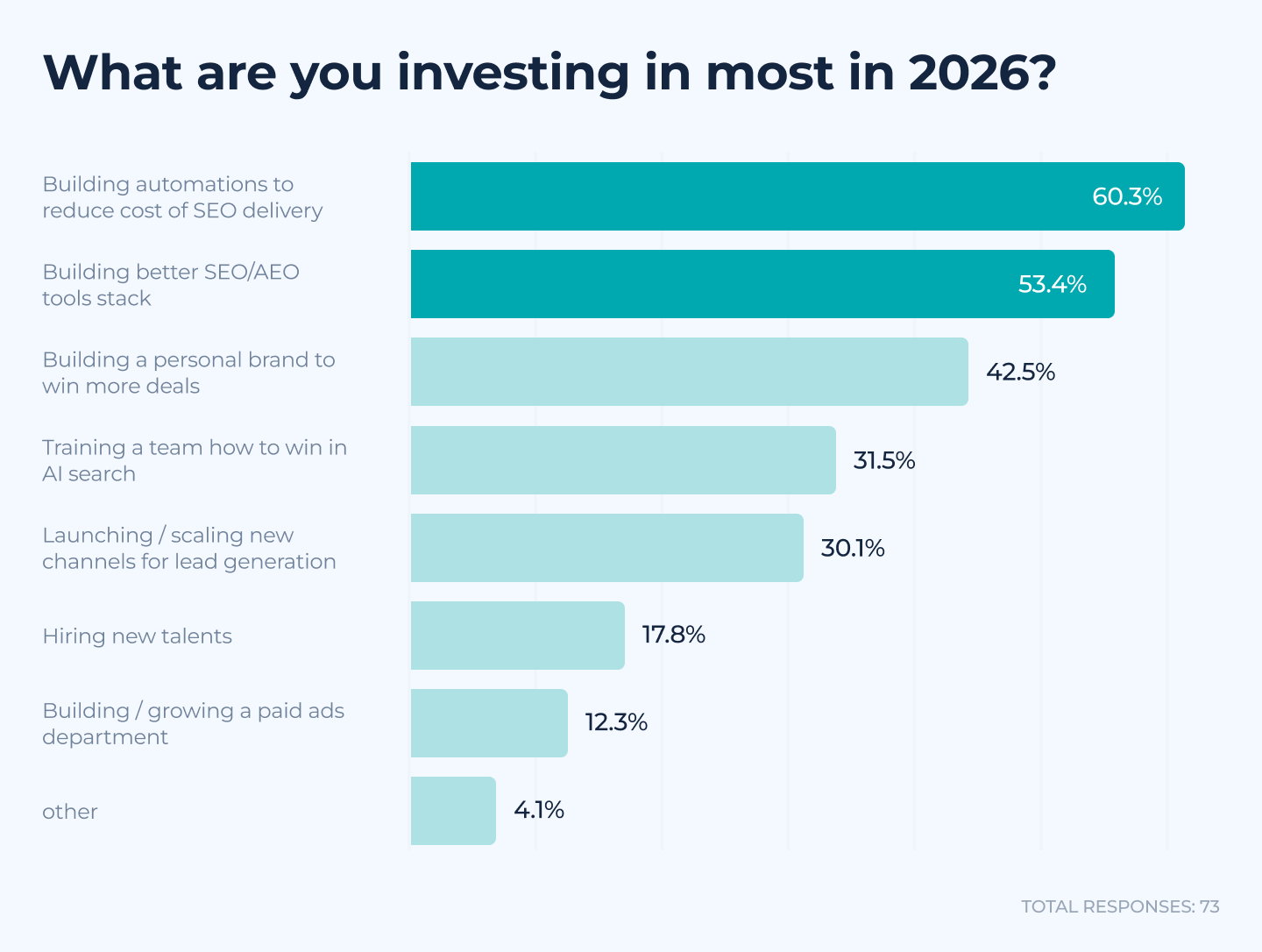
42.5% are investing in building a personal brand to win more deals. 31.5% are training teams on how to win in AI search. 30.1% are launching or scaling new channels for lead generation.
Hiring new talent ranks at 17.8%. Only 12.3% are building or growing paid ads departments. Agencies see more value in doing more with current teams than expanding the number of employees.
Most used SEO and AEO tools
- Google Search Console dominates at 93.2%.
- Google Analytics 4 comes in second at 83.6%.
- Screaming Frog ranks third at 72.6%.
- Looker Studio sits at 67.1%.
- Traditional tools like Semrush (49.3%) and Ahrefs (48%) remain popular.
- Sitechecker is gaining ground at 26%.
- New tools like Keyword Insights (15.1%) and Seogets (11%) are also seeing adoption.
The wide variety of tools in use tells us something. No single platform has solved all agency needs. Tech stacks are fragmented.

Conclusion
SEO agencies in 2026 are being careful about how they change. Yes, most are growing and charging more. But they’re not making much profit. And clients are asking more questions about whether SEO is actually worth it.
AI search is creating big problems. The agencies that will do well are the ones that can show they’re making money for clients. They explain their value in clear ways. They change how they measure success to match what’s happening with AI search.
The agencies that keep using old measurements and wait for things to go back to normal? Those are the ones losing clients to Google Ads or other agencies.
What agencies choose to spend money on shows what’s really going on. They know they need to work smarter. They’re building better tools. They want to use real numbers to prove they’re helping clients make money. They’re teaching clients what good results look like when AI is changing how search works.
Not having enough new clients is still the biggest problem. But the second biggest problem is that AI is making people think SEO doesn’t matter as much anymore. Fixing that problem with better ways to measure results, clearer explanations, and actual proof of success – that’s what will decide which agencies succeed and which ones fail.

![Google Analytics 4 Pros, Cons & Alternatives [2023 Comparison]](https://sitechecker.pro/wp-content/uploads/2023/06/image.png "Google Analytics 4 Pros, Cons & Alternatives [2023 Comparison]")